Well, the one-way train ticket to Toronto is booked. I leave on Wednesday with no apartment or job lined up, but I’m confident in my decision and hopeful that things will quickly fall into place. Besides packing and seeing friends and having little panic attacks, I have a lot of museums to visit in my final week in Montreal. At this point I have to acquiesce to the fact that I won’t complete my mission. I need to spend some of this week just doing nothing, decompressing a bit. However, I will have almost seen all that Montreal has to offer.
I’ve visited many random museums over this last year, some of which surprised me, and some I could have lived without. In my last week I will be making time for the ones I really want to see, and the ones that don’t require me to travel to the edge of the island. My parents will be joining me on several little adventures this week, which makes me happy. I can definitely be an annoying person to visit a museum with. Granted I can be an excellent tour guide, but I also have a hard time not being critical or cynical. That hasn’t changed despite my efforts, although I always try to be fair in my judgments. My sister says that I ruin the experience for her by pointing out the faults, and that’s fair enough. My mom continues to let me drag her to places, and even my dad is getting in on the action this week. Hopefully I’ll introduce them to some interesting new things.
Sunday, August 29, 2010

Monday, August 2, 2010
Pointe-à-Callière, Montreal Museum of Archaeology and History
Everyone who knows me well knows that I can't stand this museum. I recognize that I was disappointed when the Prison museum was objective, but I do generally expect that exhibitions will reflect scholarship and not personal agendas. PaC has always struggled to be objective, their text is usually frustratingly laughable, and their permanent collection is so outdated. I didn't have high hopes for their current offering about Easter Island.
And I was pleasantly surprised. Negatives first. The temporary exhibit space is one of the most poorly designed galleries I've ever visited. The space has narrow passageways with text on one side and objects on the other. It requires one to either do two circles around the space or constantly zig back and forth. There were a few textual errors but by and large it was the best temporary exhibition I've ever seen at PaC. The exhibit designer did a wonderful job with the graphics and imagery that gave wonderful reference points for understanding scale and time periods. There were a lot of interesting facts and details. Who knew that there are no large shells on Easter Island. Don't know if I needed to know that, but it was interesting.
The permanent collection has text on neon coloured lightboxes. Its so painful I could barely look at them. I suppose I've seen it so many times that its no longer particularly interesting. I think its a good school/tourist destination. Why not walk through Montreal's old sewers that have pigeons projected on the side? My favourite part of the museum is their audiovisual terminals, which goes against everything I believe in. However, its my favourite because they are so friggin awful you can't help but laugh. Actors portray different people from early Montreal. A touch screen allows you to ask the characters questions, sort of like those Choose Your Own Adventure books. I suppose they provide an interesting entry point into life in early Montreal, but I usually just end of laughing hysterically at the crappy acting and odd choice of questions. They have to be seen to be believed.
20 down. 12 to go.
And I was pleasantly surprised. Negatives first. The temporary exhibit space is one of the most poorly designed galleries I've ever visited. The space has narrow passageways with text on one side and objects on the other. It requires one to either do two circles around the space or constantly zig back and forth. There were a few textual errors but by and large it was the best temporary exhibition I've ever seen at PaC. The exhibit designer did a wonderful job with the graphics and imagery that gave wonderful reference points for understanding scale and time periods. There were a lot of interesting facts and details. Who knew that there are no large shells on Easter Island. Don't know if I needed to know that, but it was interesting.
The permanent collection has text on neon coloured lightboxes. Its so painful I could barely look at them. I suppose I've seen it so many times that its no longer particularly interesting. I think its a good school/tourist destination. Why not walk through Montreal's old sewers that have pigeons projected on the side? My favourite part of the museum is their audiovisual terminals, which goes against everything I believe in. However, its my favourite because they are so friggin awful you can't help but laugh. Actors portray different people from early Montreal. A touch screen allows you to ask the characters questions, sort of like those Choose Your Own Adventure books. I suppose they provide an interesting entry point into life in early Montreal, but I usually just end of laughing hysterically at the crappy acting and odd choice of questions. They have to be seen to be believed.
20 down. 12 to go.
And the winner for the worst museum in Montreal goes to...
...Exhibition Centre La Prison-des-Patriotes. I still have a dozen museums to see but I'd wager that this one will remain the worst of the bunch.
The Prison-des-Patriotes, located in the basement of the Au Pied-du-Courant building, presents an exhibition on the 1837-1838 rebellions in Lower Canada, the background to the Patriote movement and the impact of these events on political life in Québec and Canada. Fine. But I was expecting a prison and instead there was just text panels. Large blown up images and text panels. I was expecting the information to be totally biased and nationalist and thus kind of amusing but sadly it was objective and fairly uninteresting. I was expecting to be offended in a highly comical way, in fact I had promised my companion that the museum would be flamingly nationalist, but it wasn't. Which obviously is a good thing, but I suppose the point is that museum went too far in the direction of boring.
If you are going to have a museum without objects, then the ideas presented should be weighty. This is not a museum of ideas, in the sense of a human rights museum (which would include objects), it is a straight up history museum. I didn't read much of the information, or take the guided tour which probably would have been quite informative, but I did skim the entire space and it was no more interesting than reading a Quebec history textbook. They could have recounted the stories of individual patriots, talked about those other than the famous names, included objects from the period... It could have been in an actual prison! Luckily it was free, but they definitely shouldn't be charging. There is nothing there that a textbook doesn't have, except that galleries have larger font.The building is attached to SAQ headquarters. The SAQ sponsors an artwork in the entry way of the museum based on the relevant themes of rebellion, patriots, or, wait for it, the world of wine. Corporate sponsorship gone a little too far?
19 down. 13 to go.
Tuesday, July 27, 2010
Château Ramezay Museum
The Château Ramezay Museum is a school tour staple in Montreal. Unlike many of Montreal's history museums, the Château Ramezay has been recently updated. By recently I mean sometime in the last decade. The museum is no longer a historic home but rather a history museum in a historic building. The exhibits tell the story of the house and its history but within the broader context of the history of Montreal. The exhibition "Hochelaga, Ville-Marie, and Montréal," presents the history of Montréal, Québec, and Canada from prehistory to the early 20th century. "Life in Montréal in the 18th Century," is presented in vaults. "Hochelaga, Ville-Marie, and Montréal," lacks focus. There shouldn't be Inuit artifacts in a display about Montreal, unless their presence is explained, and links to the greater context of Québec and Canada shouldn't detract from the principal focus: Montréal.
Each room has audiovisual terminals where visitors can listen to stories of various important historical persons. When not in use creepy silhouetted ghosts float across the screen, presumable to evoke the spirits whose history haunts the house. People learn in different ways and having different kinds of entry points into the information on display is important, but I still believe that audiovisuals are largely a waste of time and money and I rarely see anyone more engaged with one than they would be with an exhibit.
I really like it when exhibitions include a panel that names the people responsible for its execution. Doing so indicates that the museum is not an anonymous authority and in theory it provides the staff with a certain amount of accountability. The permanent collection was reworked by a large group of people included half a dozen translators and editors. Knowing this makes forgiving their errors much more difficult. It amazes me that museums can present text to their visitors that is riddled with errors, and one would think that with 6 people working on editing there wouldn’t be any labels that repeat the same paragraph twice, contain misspelled artists' names or have improper terminology. Can we get past clichés like the "here the walls speak," or "the spirit of the past haunts these rooms?"
It’s a shame because the museum presents lots of good information to the public. There are consise yet thorough historical breakdowns that provide needed context as well as unique tidbits that make one museum stand out from the rest. A portrait of Ben Franklin is displayed because a reception was held for him at the Chateau, and this artifact is used as an opportunity to talk about Canada’s relationship with the United States at that time. Maps and paintings for each time period illustrate Montreal’s changing landscape.

18 down. 14 to go.
Each room has audiovisual terminals where visitors can listen to stories of various important historical persons. When not in use creepy silhouetted ghosts float across the screen, presumable to evoke the spirits whose history haunts the house. People learn in different ways and having different kinds of entry points into the information on display is important, but I still believe that audiovisuals are largely a waste of time and money and I rarely see anyone more engaged with one than they would be with an exhibit.
I really like it when exhibitions include a panel that names the people responsible for its execution. Doing so indicates that the museum is not an anonymous authority and in theory it provides the staff with a certain amount of accountability. The permanent collection was reworked by a large group of people included half a dozen translators and editors. Knowing this makes forgiving their errors much more difficult. It amazes me that museums can present text to their visitors that is riddled with errors, and one would think that with 6 people working on editing there wouldn’t be any labels that repeat the same paragraph twice, contain misspelled artists' names or have improper terminology. Can we get past clichés like the "here the walls speak," or "the spirit of the past haunts these rooms?"
It’s a shame because the museum presents lots of good information to the public. There are consise yet thorough historical breakdowns that provide needed context as well as unique tidbits that make one museum stand out from the rest. A portrait of Ben Franklin is displayed because a reception was held for him at the Chateau, and this artifact is used as an opportunity to talk about Canada’s relationship with the United States at that time. Maps and paintings for each time period illustrate Montreal’s changing landscape.
Let's Eat is a temporary exhibit that recounts the history of Quebecois cuisine. The quirky and enjoyable exhibit is the by-product of developments in food history. We learn that the 17th century church considered beaver to be a fish and the Quebecois sugar shack meal is a product of British kitchens. The exhibit compares our eating habits to that of our ancestors, explores the history of 10 of the provinces most popular dishes, and asks us to guess which products would not have been used centuries ago. Its a unique and very interesting entry point into our history.
18 down. 14 to go.
Sunday, July 25, 2010
Half-Way
My efforts at blogging over the winter were slightly lackluster. It's now July and after 8 months I'm about half-way through this project. However, since I intend on moving back to Toronto in the fall, I now have roughly a month and a half to do the remaining 16 museums. Actually the Stewart Museum is still temporarily closed so instead of 16 to go I have 15 to go. We'll see.
In part doing this project is helping to build an increasingly complete image of Montreal. Each museum adds a layer of information about this city. I've seen some really interesting exhibits, and found a few unique and exciting museums, but overall I wouldn't say that I'm particularly impressed. Although I've had contracts in my field, I haven't worked in a museum since last spring. I suppose I feel a bit out of touch and uncertain about what my future holds. That anxiety and the decision to pack up and move again in the hope of having better luck in another city may be fueling my lackluster opinions of our city's cultural institutions. Nonetheless, I believe that Montreal's museums could be telling their stories in much more intriguing ways. Financial constraints are a major factor at play, and it is obvious that the exhibits and the methodology that backs them, haven't been changed much in the last few decades. The museology and display tactics seem so so dated, which is a shame because our city has important histories and cultural stories to share.
In a sense our museums resonate issues that percolate in the socio-political landscape, both Montreal's and Quebec's more broadly. We get stuck in an ideology of protecting our minority status within Canada, of promoting a French cultural identity because no one else will do it. Fine, but at a certain point it limits this city and this province's ability to move forward. There has to be a way to embrace our unique heritage while still participating in the 21st century and accepting the diverse place that Montreal has become. This isn't necessarily revisionist history but rather a revisionist present, a more open-minded and inclusive museology.
In part doing this project is helping to build an increasingly complete image of Montreal. Each museum adds a layer of information about this city. I've seen some really interesting exhibits, and found a few unique and exciting museums, but overall I wouldn't say that I'm particularly impressed. Although I've had contracts in my field, I haven't worked in a museum since last spring. I suppose I feel a bit out of touch and uncertain about what my future holds. That anxiety and the decision to pack up and move again in the hope of having better luck in another city may be fueling my lackluster opinions of our city's cultural institutions. Nonetheless, I believe that Montreal's museums could be telling their stories in much more intriguing ways. Financial constraints are a major factor at play, and it is obvious that the exhibits and the methodology that backs them, haven't been changed much in the last few decades. The museology and display tactics seem so so dated, which is a shame because our city has important histories and cultural stories to share.
In a sense our museums resonate issues that percolate in the socio-political landscape, both Montreal's and Quebec's more broadly. We get stuck in an ideology of protecting our minority status within Canada, of promoting a French cultural identity because no one else will do it. Fine, but at a certain point it limits this city and this province's ability to move forward. There has to be a way to embrace our unique heritage while still participating in the 21st century and accepting the diverse place that Montreal has become. This isn't necessarily revisionist history but rather a revisionist present, a more open-minded and inclusive museology.
Wednesday, July 14, 2010
DHC/ART Foundation
The Power Plant gallery in Toronto likes to think of itself as the leading contemporary art gallery in Canada. Montreal's DHC/ART has a similar aim. After visiting the DHC for the first time this week, The Power Plant comes off as amateur hour in comparison. Both galleries are non-collecting contemporary art institutions. Both book major shows, do interesting curatorial work and have exhibition spaces in converted historic buildings. Yet, DHC is a privately endowed foundation, and its financial comfort is evident. Admission is free. The gallery is impressively staffed with security guards and helpful personnel. The foundation's goal is to present two exhibitions per year, as well as a program of special screenings and talks; all the while building an inclusive education and outreach program for the general public. The Power Plant also has important lectures and programs but the DHC just seems cooler and its educational offerings are much stronger than its “competitor”.
I think it’s important to have transparency and to provide visitors with the tools to interpret what they look at and the DHC’s education projects are quite impressive. Staff create a reading list for each exhibition, one in French and one in English. The list provides context for the exhibition through readings that relate to the artist or elements of their artistic practice. The list would be useful for post-secondary school trips or to enhance an individual visit. The current Jenny Holzer exhibit displays some of her text-based works that examine both the public and private realms. DHC suggests readings such as Simon Morley’s Writing on the Wall, Word and Image in Modern Art, and writings on Habermas and the public sphere. Leading visitors to sources that relate to the exhibit helps build critical thinking. Certainly not all visitors will want to take advantage of the DHC’s educational resources, but the fact that they are so thoughtfully put together and provided to the public is commendable.
While educational offerings such as the reading list expound on ideas displayed in their exhibitions, the in-gallery interpretation is solid. The brochure and text panels are smart and well written (in both French and English). The writing is smart but accessible, which isn’t always the case with contemporary art. In addition, reproductions of Holzer’s works, themselves painted reproductions of censored government emails, are available on good quality cardstock for visitors to take home and contemplate further. Looking at art, particularly contemporary art, shouldn’t be a passive experience, but for many, myself included, the act of looking is heightened when we have some context for what we are looking at. In my opinion DHC/ART helps visitors navigate contemporary art without compromising their ability to look for themselves.
16 down, 16 to go.
I think it’s important to have transparency and to provide visitors with the tools to interpret what they look at and the DHC’s education projects are quite impressive. Staff create a reading list for each exhibition, one in French and one in English. The list provides context for the exhibition through readings that relate to the artist or elements of their artistic practice. The list would be useful for post-secondary school trips or to enhance an individual visit. The current Jenny Holzer exhibit displays some of her text-based works that examine both the public and private realms. DHC suggests readings such as Simon Morley’s Writing on the Wall, Word and Image in Modern Art, and writings on Habermas and the public sphere. Leading visitors to sources that relate to the exhibit helps build critical thinking. Certainly not all visitors will want to take advantage of the DHC’s educational resources, but the fact that they are so thoughtfully put together and provided to the public is commendable.
While educational offerings such as the reading list expound on ideas displayed in their exhibitions, the in-gallery interpretation is solid. The brochure and text panels are smart and well written (in both French and English). The writing is smart but accessible, which isn’t always the case with contemporary art. In addition, reproductions of Holzer’s works, themselves painted reproductions of censored government emails, are available on good quality cardstock for visitors to take home and contemplate further. Looking at art, particularly contemporary art, shouldn’t be a passive experience, but for many, myself included, the act of looking is heightened when we have some context for what we are looking at. In my opinion DHC/ART helps visitors navigate contemporary art without compromising their ability to look for themselves.
16 down, 16 to go.
Sunday, July 11, 2010
Sir-George-Étienne-Cartier National Historic Site of Canada
Part of the idea of this project was to re-acquaint myself, or in many cases acquaint myself, with different areas of Montreal. This past weekend I visited Old Montreal and spent an afternoon visiting three different museums. The first was Sir-George-Étienne-Cartier National Historic Site of Canada. The building is only slightly out of the core of Old Montreal, but it made me realize how much of it I haven't seen.
The museum is operated by Parks Canada, and is an inexpensive place to visit.The site is comprised of exhibition spaces and the restored interior of Cartier's home. There aren't many historic homes in Montreal, and the Cartier house is the only restored Victorian interior on display to the public.
The exhibition section of the site leaves a lot to be desired. I couldn't help thinking about everything I would change. There were no introductory text panels to inform visitors about the exhibit's themes or raison d'etre. The first room simply has a sign that says "The railways, industrialization and political upheaval shpaed Montreal society in the 19th century." On display are coats, costumes, guns, and weird political figure dolls. One text panel tells about the fire department next to a graph with the rise in Montreal's population. It was all a bit disparate and nonsensical. The intention was probably to show the climate in the city when Cartier was in power, but there are other museums that do this better, in particular the Centre d'Histoire.
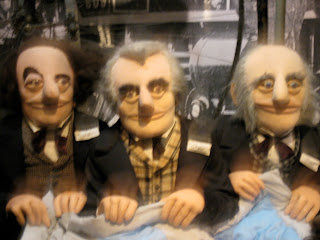
Moving on we come to a room with Cartier's personal and political history. Text panels are set up on the perimeter of the room. In the center is a round table with a glass dome in the center. Inside the dome are little wooden figures representing different stages of Cartier's life. Surrounding the table are all white male figures, presumably Cartier's cabinet or advisors. It was just all so bizare. 1980s museology?

I did learn things, albeit they may be things that I should have learned in high school. My mom gets tired of me saying I didn't learn much in high school, but in terms of Canadian history I think the Quebec curriculum is sorely lacking. Pretty much all I remember is about Louis Riel and the seigniorial system. I don't remember much of what I learned about Canada's formative years, so this museum offered a brief crash course in early Canadian history. It turns out that Cartier was responsible for the legislation that abolished the seignorial system in Montreal and for much of the city and country's modernization. The displays go through Cartier's life and accomplishments, but in a very didactic and not overly interesting way. At least the text is short and to the point.
The house part of the site is slightly more interesting. Each room has motion sensitive audio machines that play stories told my the house's staff. For example, the femme de menage tells us that Mr. Cartier rarely visited his wife's bedroom, and sometimes he would stay at a hotel even if he was in town. I'm not sure to what degree of accuracy the interior was designed to, and there are no text panels that go into detail about the decor. The dining room table is set up, including fake candles and fake food which was pretty gross, and kind of unecessary. What was really interesting was the list of all the foods they would consume at one meal. Between the first course, entrées, roasts, entrement, third course and sweets there must have been about 40 different dishes served. These kind of behind the scenes tidbits, the things that get left of textbooks, are part of what make a museum an interesting place to learn about the past. And the layers of information: textual, audio, and visual, add to the experience.
I think that there's potential here, but the displays are in desperate need of, well, being redone. On a scorching hot day it was a nice air-conditioned respite, but as a museum-experience it didn't thrill me. There were interesting sections but a lot missing.
15 down, 17 to go.
The museum is operated by Parks Canada, and is an inexpensive place to visit.The site is comprised of exhibition spaces and the restored interior of Cartier's home. There aren't many historic homes in Montreal, and the Cartier house is the only restored Victorian interior on display to the public.
The exhibition section of the site leaves a lot to be desired. I couldn't help thinking about everything I would change. There were no introductory text panels to inform visitors about the exhibit's themes or raison d'etre. The first room simply has a sign that says "The railways, industrialization and political upheaval shpaed Montreal society in the 19th century." On display are coats, costumes, guns, and weird political figure dolls. One text panel tells about the fire department next to a graph with the rise in Montreal's population. It was all a bit disparate and nonsensical. The intention was probably to show the climate in the city when Cartier was in power, but there are other museums that do this better, in particular the Centre d'Histoire.

Moving on we come to a room with Cartier's personal and political history. Text panels are set up on the perimeter of the room. In the center is a round table with a glass dome in the center. Inside the dome are little wooden figures representing different stages of Cartier's life. Surrounding the table are all white male figures, presumably Cartier's cabinet or advisors. It was just all so bizare. 1980s museology?

I did learn things, albeit they may be things that I should have learned in high school. My mom gets tired of me saying I didn't learn much in high school, but in terms of Canadian history I think the Quebec curriculum is sorely lacking. Pretty much all I remember is about Louis Riel and the seigniorial system. I don't remember much of what I learned about Canada's formative years, so this museum offered a brief crash course in early Canadian history. It turns out that Cartier was responsible for the legislation that abolished the seignorial system in Montreal and for much of the city and country's modernization. The displays go through Cartier's life and accomplishments, but in a very didactic and not overly interesting way. At least the text is short and to the point.
The house part of the site is slightly more interesting. Each room has motion sensitive audio machines that play stories told my the house's staff. For example, the femme de menage tells us that Mr. Cartier rarely visited his wife's bedroom, and sometimes he would stay at a hotel even if he was in town. I'm not sure to what degree of accuracy the interior was designed to, and there are no text panels that go into detail about the decor. The dining room table is set up, including fake candles and fake food which was pretty gross, and kind of unecessary. What was really interesting was the list of all the foods they would consume at one meal. Between the first course, entrées, roasts, entrement, third course and sweets there must have been about 40 different dishes served. These kind of behind the scenes tidbits, the things that get left of textbooks, are part of what make a museum an interesting place to learn about the past. And the layers of information: textual, audio, and visual, add to the experience.
I think that there's potential here, but the displays are in desperate need of, well, being redone. On a scorching hot day it was a nice air-conditioned respite, but as a museum-experience it didn't thrill me. There were interesting sections but a lot missing.
15 down, 17 to go.
Subscribe to:
Posts (Atom)